There are some pioneering inventions before today's computer and video games. On 18 October 1958 hundreds of visitors waited in line to play the first electronic action game, a two-dimensional tennis game played on the small screen of a cathode ray tube oscilloscope. It displayed the side view of a tennis court with a net in the middle and a bright moving point - the ball. It also had controllers to manipulate an invisible tennis racket: A rotary knob to change the angle and a trigger to "hit" the ball.
Tennis for Two
Tennis for Two is the first electronic tennis game on an oscilloscope. Specifically designed for entertainment and invention, and most of all the forefather of today's computer and video games.
On 18 October 1958 William Higinbotham showed the ancestor of today's video games to the astonished public.
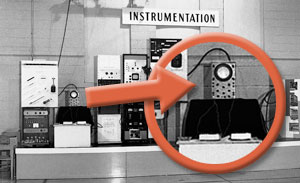
Tennis for Two (pic:BNL)
Tennis for Two is one important milestone in the history of the billion dollar computer and video game industry:
- It's the first sports game.
- It's the first game completely displaying the game graphics in real time.
- It's the first game having two controllers for two players and thus fulfilling the long-term requirements of interactivity.
- It is the first computer game that was specifically developed to entertain the public.
For further detailed information, please visit the website of Brookhaven National Laboratory.
Background information
For the sake of completeness the first patent of a technical idea in this field and the earliest known computer games have to be named.
On 14th December 1948 the first U.S. patent was requested by Thomas Goldsmith, Cedar Grove and Estler Man Ray, the Cathode-Ray Tube Amusement Device. Inspired by radar displays from World War II, a missile game with video screen overlays was developed, but never finished.
In 1951 the first graphical computer game OXO (Noughts and Crosses) was released. This Tic-tac-toe based puzzle game was run on an Electronic Delay Storage Automatic Calculator (EDSAC) Computer by Professor Alexander "Sandy" Shafto Douglas.
Spacewar! by Steve Russel, Martin Graetz and Wayne Witaenem was released in 1962 on a PDP-1 (Programmed Data Processor-1), a Digital Equipment Corporation (DEC) product. The Computer History Museum owns the last three existent PDP-1 computers. One computer with display was completely restored and is running Spacewar! as well as other programs since 2006. You can find detailed information at the PDP-1 Restoration Project website of the Computer History Museum in Mountain View, California.
Other Gaming Milestones

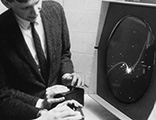 Cathode-Ray Tube Amusement Device, OXO and Spacewar!